
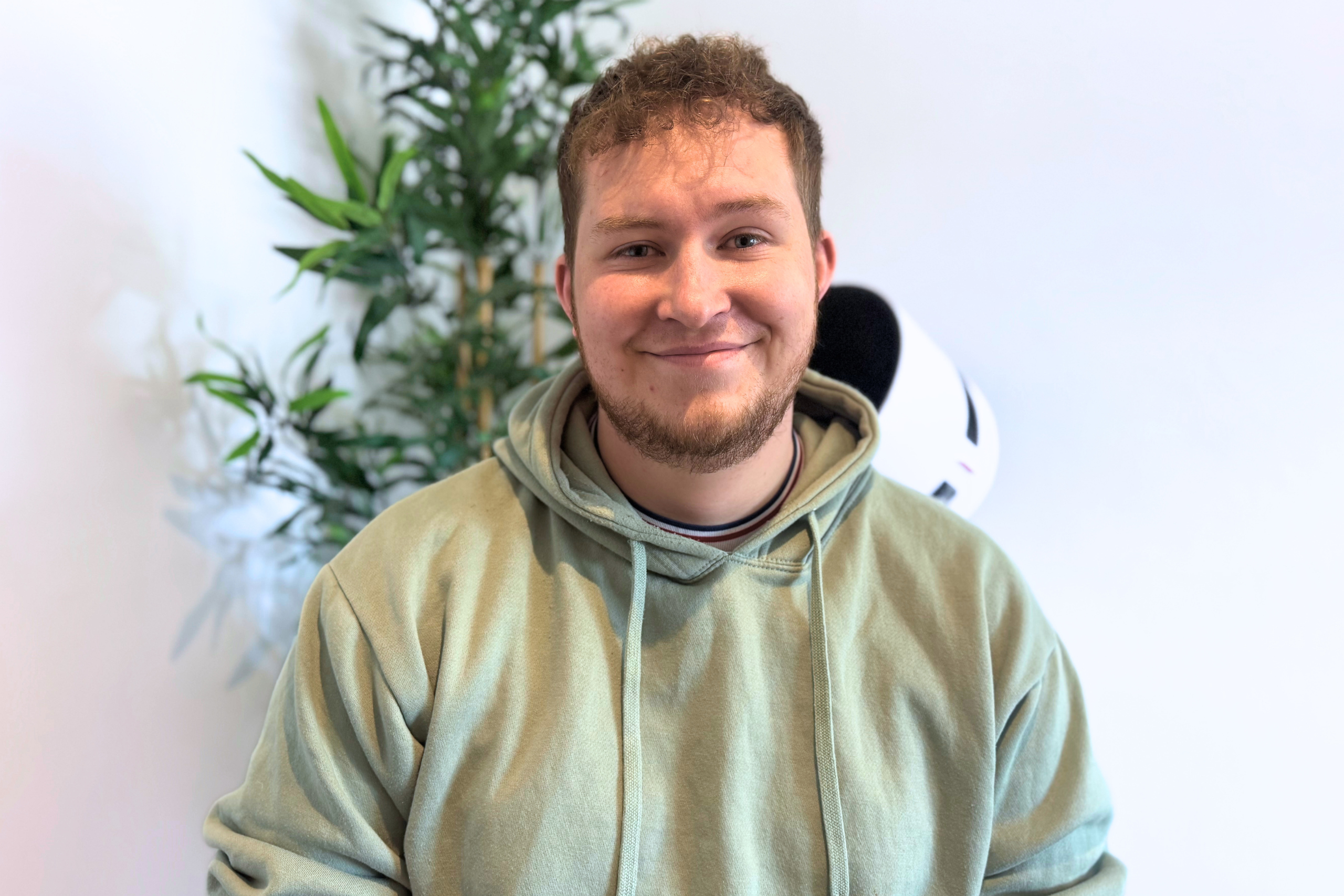
The People Behind the Work: A Conversation with Rob
For our latest spotlight, we’re continuing our series of interviews that shine a light on the people working behind the scenes at The Carpenter’s Arms. These conversations give insight into the day-to-day work that helps keep our charity running smoothly and supports the recovery journey of the people we work with.
We spoke with Rob Fairlamb, one of our brilliant Support staff, about what drew him to the role, how he supports men in Phases 1 & 3, and through their transition into Phase 2, and how his own journey through the programme informs the support he gives today.
What made you want to work at The Carpenter’s Arms?
On 14th February 2023, I started my journey with The Carpenter’s Arms underweight, angry at the world, and lost. I was shown kindness and given food, shelter, and love. That has stayed with me ever since – I’m a big believer in family. I made my way through the programme, learning, talking about my feelings and emotions, changing, and growing. I remember that experience and how it saved my life, and I want to help other people experience the change that recovery brings. This is who I am. This is my family.
Can you tell us a bit about your role and what working looks like day-to-day?
I’m currently a Phase 1 and Phase 3 keyworker. This means I support and help clients in both phases with sorting debts, filling out forms, understanding themselves, talking through difficulties, setting up bank accounts and ID, and moving forward onto the next steps. In Phase 1, we have 24 clients, and I have a further 4 in Phase 3, so 28 in total, which keeps my week busy. Although it’s busy, I make time for everyone, as it’s important that people feel safe.
What are some of the main challenges residents face when they first come into Phase 1?
Often, when a client comes into Phase 1, they don’t know what to expect. They usually already have their barriers up, so a main challenge is dismantling those barriers so we can work together to rebuild their future. A lot of clients come into the programme in debt and feeling stressed due to pressure from family and past priorities. Helping them to focus on one thing at a time is one of the biggest challenges.
How does your role support residents during this early stage of their recovery?
My role supports clients by helping them to see that change is possible. I understand how important it is, especially early on in recovery, to be surrounded by people who lead by example. We need to relate to clients, otherwise they can feel alone, even when they’re surrounded by people – which is a very difficult place to be.
How do you help prepare residents to move from Phase 1 into Phase 2?
The move from Phase 1 to Phase 2 may seem small, but it can feel very daunting for a client. They’re leaving behind 11 people they’ve often cried with, laughed with, and supported, even in a short space of time. Then they move into a building four times the size, with 28 other clients they don’t know, which can feel overwhelming. I support clients by going through the timetable with them, explaining who their next keyworker will be, and letting them know they’ll have a buddy to show them around. I also reassure them that staff are always available if they need someone to talk to. It’s important that clients know we’re here for them.
What changes do you tend to see in residents as they begin to move towards Phase 2?
When a client is moving towards Phase 2, you start to see small changes. One of the most common questions I get is, ‘When do you think I’ll be moving to Phase 2?’ – I hear it a few times a day. Clients often become either nervous or excited about the change.
What has surprised you most about working at this stage of the programme?
What has surprised me most is a difficult question, because not a lot surprises me anymore. I’ve been working in Phase 1 since I started giving back, and I’ve been around it for a long time. If I think back to when I first started, what surprised me was seeing clients who didn’t want to change. It upset me more than it surprised me, but it taught me an important lesson – that we can’t give up on people.
What’s been the most rewarding part of working with residents?
For me, the most rewarding part of working in Phase 1 is seeing people who feel lost and broken begin to come back to life. Being part of a client’s journey is huge. I have former clients I’ve key worked, from all over the country, who still message me to say how well they’re doing. That feeling – knowing that the lost, broken person I once was, has now helped someone else do the right thing – means everything to me.
Take the first step towards recovery today.
Contact us for confidential support and guidance.


Building a foundation for a brighter future
A safe and nurturing environment where individuals living with addiction can find unfailing support, care and guidance

The programme
Overcome your drug and alcohol addiction through our three-step residential programme.
Read more
How to apply
The first step is always the hardest. Let’s show you what it takes to recover from addiction.
Read more
Support us
Join us in making a difference to the lives of men and families blighted by addiction.
Read more

When I left the Military, I had problems in my marriage and was a victim of domestic abuse. I totally lost it and turned to alcohol. The Carpenter’s Arms were willing to take me on and knowing they were signed up to The Armed Forces Covenant was a big thing for me. I have grown with the programme, and I have now got self-worth. I wake up every morning thankful. I’m blessed.
Brian, resident
As a magistrate, I see the devastation of addiction to a person’s life, as well as their family and friends, when they end up in the Court system. The Carpenter’s Arms offers an opportunity, strategies and support to face and overcome addiction, and turn people’s lives around. It offers people hope at their lowest ebb to gain self-confidence and self-worth which are invaluable gifts.
Mrs Henrietta Chubb JP, High Sheriff of Leicestershire
I got out of prison on the 14th of December 2017 and went straight to The Carpenter's Arms and felt the labels go. My first clean test in 24 years felt amazing. I had never seen my little girls through clean eyes. It was overwhelming! All the victories that were coming for me just for being in this place.
Garry, resident
I’ve known The Carpenter's Arms now for several years and it's great to see the way in which they have grown. What they've done in terms of supporting the defence community has been extraordinary. They show such great enthusiasm and such an ability to reach into people's lives.
Bruce Spencer, MoD Employer Engagement Director for the East Midlands
Before my arrival at the Carpenter's Arms, I was lost in a very dark place, haunted by past memories, suppressed by the use of drink and drugs. A local Christian charity recommended The Carpenter's Arms and I was thrown another lifeline and my hope was restored. My spirit, body and soul have been renewed, and I have re-established family connections and built bridges I once burnt.
Bradley, resident
The Carpenter’s Arms is one of our alliance charities working in the area of addiction. We draw on their understanding of what's going on, and their work and solutions for people living with addiction. It helps support our policy and working forward to sustainable living and aspirations in life after addiction.
Steve Meadwell, Regional Manager (Midlands), Centre for Social Justice
I have been suffering from mental health for over 10 years and was addicted to crack, cocaine, cannabis, and steroids. My life was unmanageable. My life has changed completely and I’ve been able to see my son again. I was lost and broken and now I am blessed. I am now a House Dad in phase 3 and I’ve been put on the Pathways as a Support Worker.
Blake, resident
I'm the trustee of the Carpenter's Arms and, this year, I’m also the Mayor of Charnwood. I first met Brian and Judith when I was a Magistrate Chairman of the Drug Rehabilitation Committee. The most rewarding experience was when I finished sitting on the bench and watched the amazing successes at The Carpenter’s Arms in capacity as a trustee. To sit and listen to the clients tell their stories, what they have done and how they have come out the other side with new beginnings, I think for me is the most rewarding. The court couldn’t do it, but The Carpenter's Arms did.
Councillor Margaret Smidowicz, Mayor of Charnwood and trustee of The Carpenter’s Arms
After years of hard drug addiction and causing a lot of pain and suffering for myself and my loved ones, I walked through the doors of the Carpenter's Arms. In the space of a few weeks, I started to see and think more clearly and within months my life had changed drastically for the better. I can't thank the Carpenter's Arms enough for giving me a second chance at life.
Marcus, resident
I've been an alcoholic for 3 years. Whilst it has been a challenge at The Carpenter's Arms, I have been clean for 1 month, have more energy and motivation to do things. A routine has helped me a lot, as well as being able to be around people which has helped me speak more easily. I am excited to go back to work and see my family more.
Rob, resident
I was a broken man after 16 years addicted to heroin and crack, with no confidence or self-worth. Through coming to the Carpenter's Arms, I have been able to break free from my addiction, have learnt how to love myself, how to treat others and how to deal with everyday life without drugs. I am now happily married with 6 beautiful kids and have had a job for the last 6 years.
Scott, resident